Flour on the Bench: What Wholegrain Changes in a Dough
Bran and germ change how flour takes up water and how dough responds to mixing, resting, and shaping. Learn what to watch for—and why wholegrain flours need individual attention.
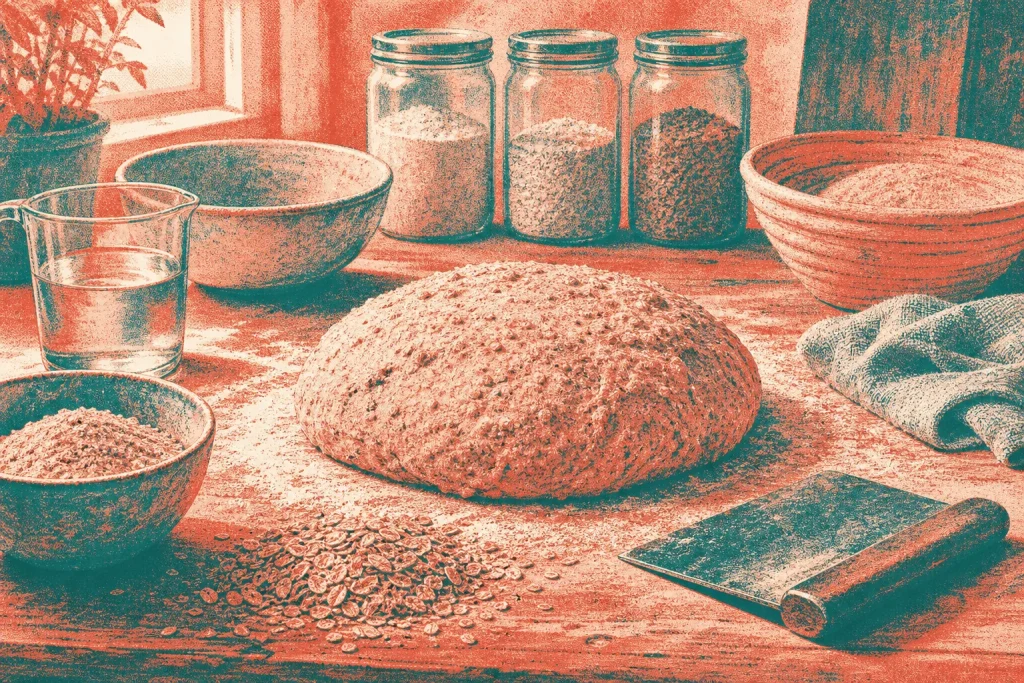
The common mistake is to replace white flour with wholegrain flour while keeping the water and mixing exactly the same. The dough may turn stiff, feel rough, or resist shaping, and adding water in a hurry can leave it sticky before the bran has had time to soften. Wholegrain flour is not simply white flour with extra bits: bran and germ change how dough absorbs water and behaves on the bench.
Read the flour
Wholegrain flour contains the bran and germ as well as the starchy endosperm. Bran is the seed’s outer covering; germ is the part from which a new plant can grow. Their proportions, particle size, and condition vary by grain and milling, so two wholegrain flours can produce noticeably different doughs.
Start with the label and the flour itself. A finely milled whole-wheat flour often blends into dough more readily than a coarse meal with visible flakes. Rye, whole spelt, and whole wheat each bring their own balance of starch, protein, fiber, and milling texture. The word “wholegrain” alone does not tell you how much water a particular flour will take up or how elastic its dough will feel.
Look at the grind before mixing. If the flour feels sandy between your fingers or contains obvious bran flakes, expect a more textured dough and allow time for those particles to absorb moisture. A fine, soft flour may hydrate more quickly, though it still won’t behave exactly like refined flour.
Notice water uptake
Bran and other wholegrain particles bind water. Some of that water is taken up gradually, so a dough that seems firm immediately after mixing may soften during a rest. The rest period is sometimes called autolyse when flour and water are mixed and left before salt and other ingredients are added. The term describes a useful method, not a requirement: even a brief pause can make the dough easier to assess.
Mix with a small reserve of the recipe’s water rather than pouring it all in automatically. Once the flour is moistened, pause and let it sit. Then squeeze or fold a piece of dough between your fingers. If it feels dry and tears at the edges, work in a little of the reserved water. If it is already slack, hold back the rest.
Judge the dough after it has rested, not just at the moment the mixer stops. Like a dry sponge that becomes more pliable as it soaks, flour can change feel as it takes in water. The analogy has limits—dough also develops structure through mixing—but it helps explain why an immediate impression may mislead.
Give bran time
Coarse bran can make a dough feel gritty or resistant because its particles take longer to soften. A rest lets them hydrate before you ask the dough to stretch. It can also make mixing feel smoother, without eliminating the bran or changing the flour’s underlying character.
For a particularly coarse flour, some bakers soak the bran separately with part of the recipe’s water, then add it to the dough. This can reduce the sensation of dry, sharp particles during handling. Keep the soak water within the recipe’s total water rather than treating it as extra; otherwise the dough may become wetter than intended.
Resting does not mean leaving the dough unattended indefinitely. If the recipe includes a long fermentation, account for that schedule and the dough’s temperature. The practical aim is to give dry particles a chance to hydrate before judging whether more water is needed.
Expect a different feel
Wholegrain dough may feel less smooth and extensible than a white-flour dough. Bran can interrupt the continuous gluten network—the stretchy structure formed by wheat proteins when flour and water are mixed. A dough can still hold together and rise well, but it may not stretch into a thin, even sheet as readily.
Use your hands as sensors, not just as tools. A tacky surface is not automatically a problem: dough can cling lightly and still be workable. A dry, cracking edge suggests it needs more moisture or more rest. A dough that spreads rapidly and smears across the bench may be too wet for the way you intend to shape it, or may need another rest and fold before you decide.
A bench scraper helps move sticky dough without burying it in extra flour. Lightly wet hands can also help with folds. If the dough is firm and rough, a short pause is often a better first response than kneading harder.
Handle without forcing
Wholegrain dough often responds well to gentle folds spaced through the early part of fermentation. Each fold gathers and strengthens the dough while keeping handling measured. Pull one side upward only until it begins to resist, then fold it over the center. Rotate the bowl and repeat, stopping if the dough starts to tear.
Aggressive kneading is not a cure for every rough feel. If coarse bran is cutting through the dough’s developing structure, more force may make the surface ragged rather than supple. Rest first, then use a few deliberate folds. For very dense or coarse doughs, a pan loaf can be a more forgiving shape than a freestanding round because the pan supports the sides.
Say you are making a wheat loaf with a finely milled whole-wheat flour and the dough feels tight just after mixing. You reserve some recipe water, cover the dough for a short rest, then check again. If it has softened but still cracks when folded, you add a small splash of the reserved water and mix it in gently. The expected observable result is a dough that bends more readily without becoming puddled; if it remains firm, you can give it another rest before changing the formula further.
Keep flour distinctions
Whole wheat is not interchangeable with whole rye or whole spelt. Rye has a different structure from wheat and does not form the same elastic gluten network; a rye-heavy dough can feel sticky and paste-like rather than springy. Spelt dough may stretch readily but can become fragile if worked hard. Those differences affect what “ready to shape” feels like.
Even within one grain, milling matters. A stone-ground flour with coarse bran may absorb water and feel different from a finely sifted wholegrain flour. Freshness and storage also matter: flour kept exposed to air can lose its fresh aroma, while flour stored cool and sealed is less exposed to moisture and odors. These are reasons to adjust by observation rather than rely on a fixed water change for every bag.
When changing flours, keep the rest of the formula steady at first. Note the flour name, grind, how much water you held back, and how the dough felt after resting. That small record helps distinguish a flour’s behavior from changes caused by mixing, room conditions, or fermentation.
Choose a useful adjustment
If the dough is dry after resting, add water gradually and let it absorb before adding more. If it is tacky but holds its shape, use a scraper and damp hands rather than dusting the bench heavily. Excess bench flour can work into the dough in uneven patches and make the outer surface drier than the center.
If the dough tears during a fold, stop pulling. Cover it and let it relax, then try again with a smaller movement. If it spreads without recovering, consider whether the flour is suited to a freestanding loaf or whether the dough needs more strength from folds, a pan, or a different blend. Do not expect added water alone to solve weak structure; hydration and strength are related but separate questions.
Wholegrain flour asks for closer attention to time and touch, not a single universal correction. Let the particles hydrate, assess the dough after a pause, and make small changes that suit the specific grain and grind on your bench. That approach preserves the flour’s character while making its handling easier to read.