Steam, Crust, and the First Minutes in the Oven
Steam can keep a loaf’s surface moist early in the bake, but the effect depends on the dough, oven, and method. Compare covered cookware, a steam tray, and other options while keeping hot equipment manageable.
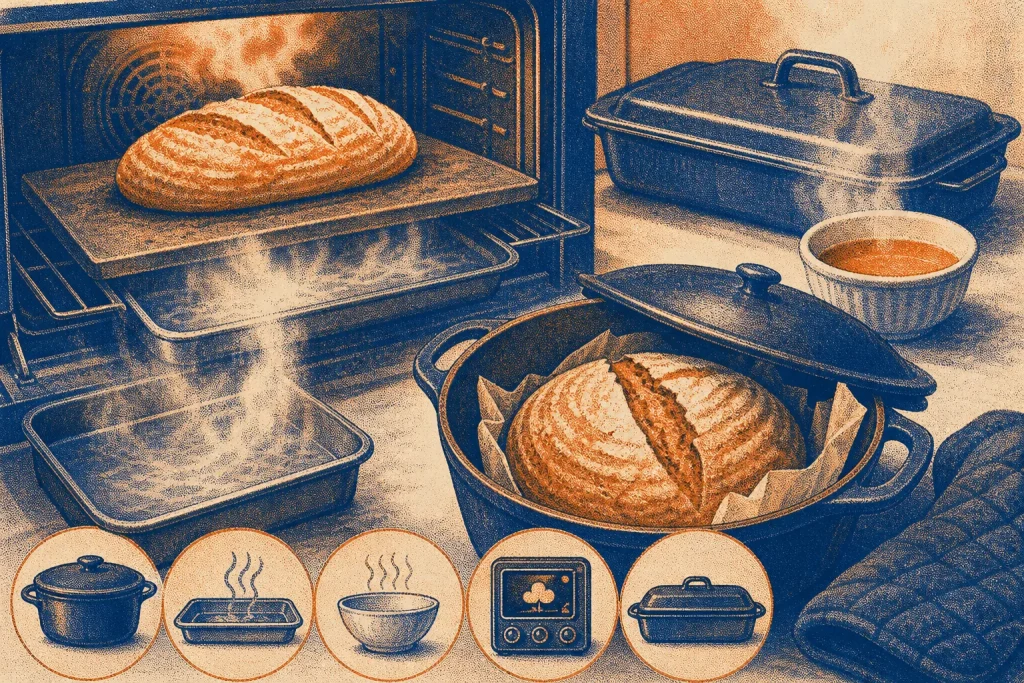
The common mistake is opening the oven door to add water after the loaf goes in. That lets heat escape and brings hands close to hot surfaces, while the amount of steam produced may be hard to control. A simpler aim is to keep the loaf’s surface moist during the early bake, when the dough may still stretch before its exterior sets.
Steam does not make bread rise by itself. Gases already in the dough expand as it heats, and the surface gradually warms and firms. Moist air may slow that surface from setting, giving the loaf more opportunity to open at its score. How much expansion or crust change you see depends on the dough, shaping, oven, and bake; steam alone cannot assure either result.
Covered cookware
A lidded Dutch oven or heavy oven-safe pot can trap moisture released by the dough. Preheat it only as its manufacturer directs, lower in the shaped loaf using parchment as a sling if suitable for the vessel and baking conditions, then replace the lid. The enclosure keeps moisture close to the loaf without adding water to the oven.
This method often suits a single round loaf, though a narrow pot may constrain a broad one. The vessel and lid are hot and can be awkward to handle, so use appropriate oven mitts and put the lid on a heat-safe surface. After the covered portion of the bake, remove the lid carefully if the recipe calls for an uncovered finish.
A lidded roasting pan can offer more room for an oval loaf. Depending on its design, place the loaf on a suitable baking surface and cover it with the pan, or bake inside the pan with its lid. Before heating, check the manufacturer’s instructions for both pieces and confirm that they sit stably together. Do not improvise with cookware that may tip, warp, or be difficult to lift.
Water trays
A sturdy metal tray intended for oven use can release steam when water is added. Place the empty tray below the bread during preheating. After loading the loaf, add hot water carefully without splashing and close the oven door. This method leaves the loaf uncovered, so moisture spreads through the oven and may escape more readily than it would inside a covered pot.
Follow the oven and tray manufacturers’ instructions, and keep your face and hands away from rising vapor. Do not pour water onto oven glass, a hot baking stone, or an oven light. Sudden temperature changes can damage some components; if you are unsure what your oven permits, consult its manual or use a covered method instead.
Some bakers place clean lava rocks or stainless-steel nuts in a dedicated metal pan to provide more hot surface area for evaporation. This is optional, not a requirement for good bread. Use only materials whose manufacturer identifies them as suitable for repeated oven heating, and keep them contained in a stable, oven-safe pan. Avoid coated, galvanized, or unidentified objects. If the material or cookware is uncertain, skip the setup and choose a method supported by the appliance and cookware instructions.
Gentler humidity
An oven-safe bowl of hot water can add humidity, but its effect is usually less direct than covering the loaf or adding water to a preheated tray. Place it where it cannot interfere with the loaf or heating elements, and use a bowl explicitly rated for oven use. Ordinary glass or ceramic may not be designed for oven heat or sudden temperature changes.
Think of the bowl like a damp towel in a room, while a covered pot is more like a lid over a saucepan: both can add moisture, but one contains it closer to the source. A bowl may suit someone seeking a simple, modest source of humidity, provided the oven and bowl instructions allow it.
Built-in steam
Some ovens have a steam setting or a reservoir designed for baking. Follow the appliance manual for filling, mode selection, and cleaning; controls and limits vary by model. A built-in system can make steam easier to manage, but loading promptly and judging the crust by its appearance still matter.
If the oven offers several steam settings, use the one the manual identifies for bread rather than assuming that more steam is better. Follow its guidance for ending the steam phase and finishing with dry heat. The crust’s texture will also depend on the dough and the rest of the bake.
Matching methods
Choose a method that fits the loaf and the equipment you can handle calmly. A round loaf may fit a Dutch oven; a long loaf may be easier under a roomy roasting pan or on a baking surface with a steam tray below. A covered pot can be awkward when baking several loaves, while an uncovered tray method may serve a larger oven area. In each case, consider how you will load the dough, contain moisture, and move hot cookware without rushing.
Say you have an oval sourdough loaf, a baking steel, and a dedicated metal tray that the oven manual permits you to use for water. You put the empty tray below the steel during preheating, then transfer the loaf with a peel and add hot water to the tray without splashing. You close the door and watch the score and crust through the window. If the dough expands at the score before the crust firms, that is consistent with the intended effect; if it does not, the result could reflect the dough or other baking conditions, not simply a lack of steam. You finish the bake according to your recipe, allowing the crust to brown in dry heat if directed.
Whichever method you choose, keep steam away from your hands, oven glass, and electrical components. A brief early steam phase followed by dry heat may suit many loaves, but follow the recipe and appliance guidance. If cookware or an oven feature is uncertain, check its manual and choose a method with clear instructions.